
If muscle recovery in Clearwater FL feels harder than it used to, you are not imagining it. You push hard on a Saturday — a long run, a tough workout, a full day of physical activity — and feel fine by Monday. Now that same effort takes until Wednesday to shake off, if it shakes off at all.
You are not out of shape. Your body’s recovery biology has genuinely changed, and it started changing right around 35.
The good news: this is not something you just have to accept. Here is what is actually happening — and what people in Clearwater are doing to get ahead of it.
What Slows Muscle Recovery After 35 (replaces “What Changes After 35”)
Recovery slowdown is not one thing. It is the compounding effect of several physiological shifts that begin in your mid-thirties and accelerate from there.
Inflammation stays elevated longer. In your twenties, the inflammatory response triggered by exercise or stress resolved quickly. After 35, baseline inflammation tends to run higher and linger longer — meaning you start the next workout or workday already behind.
Mitochondrial output declines. Your cells produce less ATP (the energy currency that powers repair and regeneration), which means tissue recovery, muscle rebuilding, and cellular maintenance all slow down.
Circulation becomes less efficient. Blood flow to peripheral tissue — muscles, joints, extremities — decreases with age, reducing the delivery of oxygen and nutrients that drive recovery and the clearance of metabolic waste that causes soreness and stiffness.
Human growth hormone drops. HGH is one of the body’s primary recovery signals. Levels begin declining in the mid-thirties, which directly affects how quickly muscle tissue repairs itself after stress.
None of this is catastrophic. But left unaddressed, it accumulates — and that accumulation is what makes 38 feel so different from 28.
Cryotherapy for Muscle Recovery in Clearwater
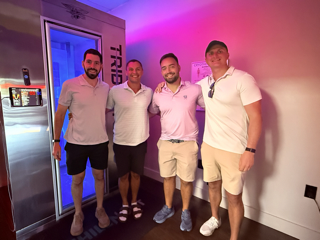
Cryotherapy is one of the most direct tools available for interrupting the prolonged inflammatory cycle that slows recovery after 35. A two-to-three minute session in the electric cryotherapy chamber triggers a powerful vasoconstriction and vasodilation sequence — blood pulls to the core, then surges back through the body loaded with oxygen and anti-inflammatory compounds.
The result is a rapid reduction in systemic inflammation, a release of endorphins and norepinephrine that blunts pain and elevates mood, and a metabolic signal that prompts the body to accelerate tissue repair.
For clients in their late thirties and forties, consistent cryotherapy use helps reset the inflammatory baseline — so recovery starts from a better place every time.
Best for: Post-workout soreness, inflammation management, energy and mood reset, joint stiffness
Red Light Therapy: Faster Muscle Recovery at the Cellular Level
The mitochondrial decline that begins after 35 is one of the primary drivers of slower recovery — and red light therapy works directly at that level. Using 660nm red and 940nm near-infrared wavelengths, our full-body red light bed penetrates deep into tissue and stimulates the mitochondria to produce more ATP.
More ATP means faster cellular repair, better tissue regeneration, reduced inflammation at the cellular level, and improved circulation to areas that need it most. Research has documented benefits across a wide range of recovery and performance markers — from reduced muscle damage after exercise to accelerated healing in joints and soft tissue.
For the 35-44 demographic specifically, red light therapy addresses the root cause of slowdown rather than just managing symptoms. It is one of the most substantive investments you can make in how your body performs and recovers over the next decade.
Best for: Cellular recovery, inflammation, joint health, circulation, sleep quality
Infrared Sauna: Recover While You Rest
One of the underappreciated recovery challenges after 35 is that the window for passive recovery — sleep, rest, downtime — often shrinks exactly when the body needs more of it. Careers, families, and obligations do not pause for recovery.
Infrared sauna gives you a high-output recovery session in 30 to 45 minutes. Unlike traditional saunas that heat the surrounding air, full-spectrum infrared penetrates directly into muscle and joint tissue — increasing circulation, loosening connective tissue, flushing inflammatory byproducts through sweat, and activating the parasympathetic nervous system in a way that carries over into deeper, more restorative sleep.
Regular infrared sauna use has also been associated with improved cardiovascular function and reduced cortisol — both of which directly affect how well and how quickly the body recovers from physical and mental stress.
Best for: Muscle recovery, sleep quality, stress and cortisol reduction, cardiovascular support, flexibility
Compression Therapy: Clear the Backlog
When circulation slows and lymphatic drainage becomes less efficient — both hallmarks of the post-35 body — metabolic waste builds up in the muscles and connective tissue. That buildup is a significant contributor to the lingering soreness, heaviness, and stiffness that takes longer to resolve as you age.
Compression therapy uses dynamic pneumatic compression to move that backlog out. Starting at the feet and working systematically up through the legs and hips, the system mimics and amplifies the body’s natural circulatory and lymphatic processes — clearing waste, reducing swelling, and restoring the kind of fresh-leg feeling that used to come back on its own.
Sessions are completely passive. You sit back, relax, and let the system work — making it an easy add-on to any other service or a standalone session on a rest day.
Best for: Leg soreness and heaviness, post-workout recovery, circulation, lymphatic drainage, travel recovery
The Compounding Effect of Doing Nothing
Here is the part that does not get talked about enough: the recovery gap widens over time if you do not address it. The 35-year-old who ignores the early signs does not just stay at 35-year-old recovery capacity. They arrive at 45 with a compounded deficit — more inflammation, more tissue damage, more structural wear — that is significantly harder to course-correct.
The clients who come through Chill N Out Clearwater in the best shape in their forties and fifties are almost always the ones who started paying attention in their mid-thirties. Not because they did anything extreme — because they were consistent.
Start Here
If you are new to Chill N Out Clearwater, the intro offer is designed to let you experience the difference before committing: 3 sessions for $49, no membership required. Try one service or stack a few — most clients who stack sessions notice significantly more than they expected from a single visit.
For those ready to make recovery a non-negotiable part of the routine, the Everyday Wellness membership at $99/month gives you consistent access to all four modalities so the benefits build instead of reset between visits.
We are located at 2454 N McMullen Booth Rd, Suite 308, Clearwater, FL 33759. Book at chillnoutclearwater.com or call 727-250-8792.
Your recovery is not supposed to get worse every year. Let us help you prove that.
Chill N Out Clearwater is a woman-owned and veteran-owned wellness and recovery studio serving Clearwater, FL and the greater Tampa Bay area.